+86-18020396629

Leave Your Message
-
CONTACT NUMBER

-
 CONTACT NUMBER
-

Explore our specialized CNC processing centers engineered for high-efficiency profiling, routing, and jointing of fire-rated frame components.
In modern industrial and commercial architecture, fire safety is non-negotiable. Fire door assemblies serve as critical life-safety systems designed to compartmentalize fire, prevent the spread of toxic smoke, and provide occupants with precious evacuation time. While public attention often focuses on the main door leaf, the structural integrity and performance of a fire door system rely heavily on the precision engineering of its door frame components.
A fire door frame is not merely a decorative border; it is a complex assembly of jambs, casings, transoms, mullions, and integrated seals that must withstand extreme thermal stress. During a fire, temperatures can exceed 1,000°C. If the frame component warps, shrinks, or fails to maintain a tight seal with the door leaf, the fire barrier is breached. Therefore, the production of door frame components for fire doors requires absolute dimensional accuracy, specialized material formulations, and highly advanced CNC machining techniques.
Regulatory bodies such as UL (Underwriters Laboratories), British Standards (BS 476), and European Norms (EN 1634) certify fire doors as complete assemblies. This means the door leaf, frame, hinges, locks, and intumescent seals are tested together. A sub-standard frame component will invalidate the entire system's certification, emphasizing the need for zero-tolerance precision during production.
Understanding the anatomy of a fire door frame is essential for optimizing the manufacturing workflow. The primary components processed by modern CNC machinery include:
Shanghai Shuping Precision Machinery Co., Ltd. is a well-established Sino-Japanese joint venture. Its core manufacturing base is Shuping Precision Machinery (Nantong) Co., Ltd., which commenced full-scale production in 2017 and occupies a total floor area exceeding 13,000 square meters. Since its establishment in 1995, the company has consistently focused on the R&D, production, sales, and service of CNC woodworking machinery, dedicated to providing the global woodworking industry with intelligent solutions that are "faster, more precise, more accurate, and more economical."


The global market for fire-rated doors is experiencing rapid expansion, driven by stringent municipal building codes, urbanization, and a heightened emphasis on occupant safety in high-rise residential and commercial developments. Traditional manual manufacturing methods are no longer viable to meet this surging demand due to several critical market factors:
As labor costs rise and skilled woodworkers become scarce, manufacturers are adopting automated CNC processing centers. Automated lines can handle the entire machining process of a door frame—from sizing and profiling to joint cutting and hardware routing—in a single setup. This reduces handling times, eliminates human error, and ensures consistent quality across large production batches.
Modern fire doors are no longer made purely of solid wood. They utilize high-density mineral boards, calcium silicate cores, metal-reinforced composites, and chemically treated hardwoods. These materials are highly abrasive and dense, causing rapid wear on standard cutting tools. Advanced CNC machinery equipped with high-torque spindles, dust-extraction systems, and diamond-tipped tooling is required to process these components without chipping or burning the substrates.
Commercial projects rarely use standardized door frames. Every project requires custom heights, widths, wall thicknesses, and hardware prep. Modern CNC systems address this by integrating smart parametric software. By scanning a QR code on the raw material, the CNC machine automatically adjusts its toolpaths, positioning clamps, and processing parameters to execute a unique design, enabling seamless batch-of-one production.


Our technological heritage originates from Japan. Over a fifteen-year period, the company provided OEM manufacturing services for renowned Japanese enterprises, gaining profound expertise in precision machining techniques originating from Matsuhama, Japan in the 1970s.
Building upon this foundation, we established our proprietary brand CAT Shanghai in 2010 and simultaneously founded the CAT JAPAN R&D Center in Japan, ensuring our core technologies remain at the forefront of global innovation.
To manufacture door frame components that pass strict fire-rating tests, CNC machining centers must execute several complex operations with high precision. Below is an analysis of these critical application scenarios:
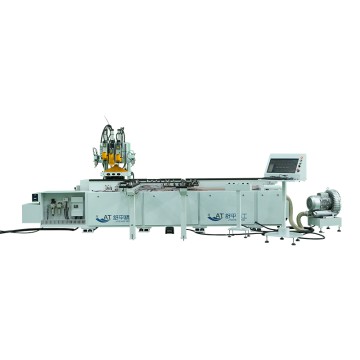
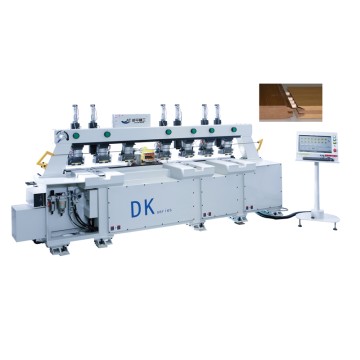
Fire doors are significantly heavier than standard interior doors due to their dense mineral cores and thick timber structures. Consequently, they require heavy-duty, multi-point hardware to prevent sagging over time. The CNC machine must cut deep, precise mortises for hinges, 3-point locks, and flush bolts. The DFH Door Frame Lock Tongue Joint Processing Center is specifically engineered for this task, ensuring that joints are executed with tight tolerances to prevent any structural play that could compromise the fire seal during a thermal event.
The groove for the intumescent strip must be milled to an exact width and depth. If the groove is too shallow, the strip may interfere with the door's operation; if it is too deep, the expansion of the strip during a fire may not reach the door leaf effectively. CNC routers must maintain a uniform depth across the entire length of the jamb, compensating automatically for any slight warp in the raw timber material.
The joints between the vertical jambs and the horizontal head must be incredibly tight. Any gap at the corners provides an easy path for smoke and fire. CNC processing centers utilize 45-degree miter cutting, dowel boring, and pocket-screw routing to ensure the frame corners can be assembled with mechanical fasteners and high-temperature adhesives to form an airtight seal.
In fire door frame production, a deviation of even 1mm can cause a failure in the smoke-leakage test. Shuping's CNC machining centers achieve 0.01mm-level precision, ensuring that the gap between the door leaf and the frame remains perfectly uniform (typically between 2mm and 4mm) around the entire perimeter, as specified by international fire test standards.
In 2017, the modern production base in Nantong, located within the Jiangsu Hai'an Economic and Technological Development Zone, officially commenced operations, marking the company's entry into a new phase of large-scale, intelligent development.
Leveraging this advanced manufacturing platform, we assembled an elite technical team comprising experts in electrical engineering, software, design, and process technology. We have accumulated over 52 nationally accepted and authorized patents, comprehensively covering the entire spectrum of wood door and panel furniture processing machinery.
Our independently developed PNC intelligent control system enables direct QR code scanning and automatic path optimization, transforming complex machining into simple, efficient operations.

To achieve high throughput while maintaining compliance with fire safety regulations, manufacturers must design an optimized workflow. A typical high-efficiency production line integrates multiple specialized CNC machines to handle different stages of the frame components:
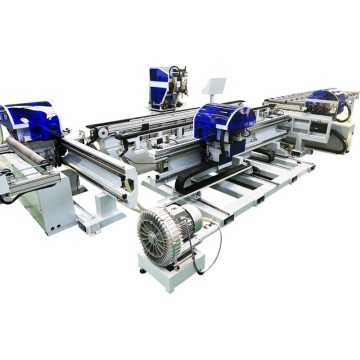
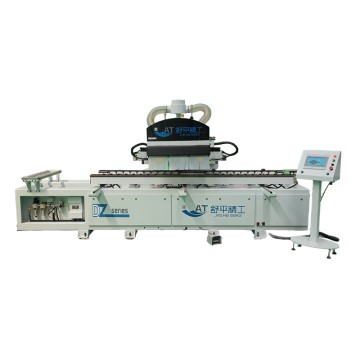
Raw solid timber or composite blanks are first processed through high-precision sizing saws to establish perfect parallelism and squareness. The DZWJ Wooden Door Four Sided Sawing Processing Center ensures that the starting blanks are perfectly dimensioned, which is critical for all subsequent doweling, routing, and profiling steps.
The frame profile—including the main rebate for the door leaf, the secondary rebate (if double-rebated), and the intumescent seal grooves—is shaped using heavy-duty spindle molders or CNC machining centers. This step requires machines with high dynamic stability to prevent chatter marks on the wood surface, which could prevent the intumescent tape from adhering correctly.
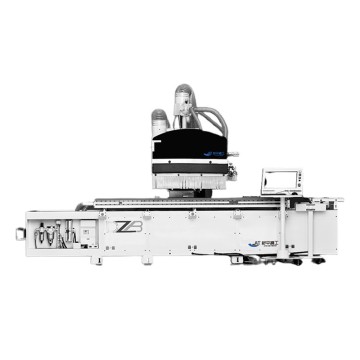
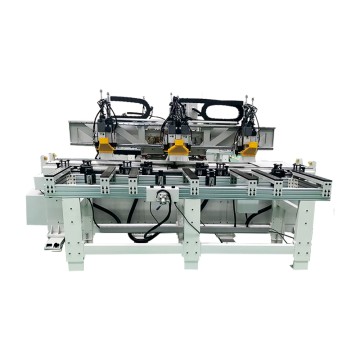
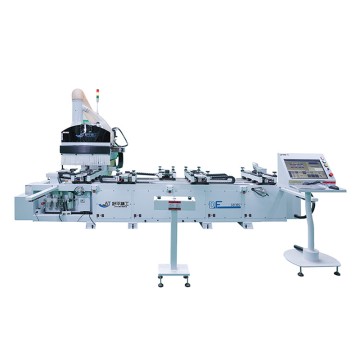
Once profiled, the jambs are transferred to specialized centers like the DF45A Wood Door Frame Processing Center. Here, hinge recesses, lock keeper plates, transom joints, and screw pilot holes are machined in a single operation. Using multi-spindle configurations allows the machine to process both ends of a jamb simultaneously, dramatically reducing cycle times.
Proven reliability and efficiency trusted by global wood processing industry leaders.
It is precisely this relentless pursuit of technology that has earned Shuping Precision Engineering widespread market recognition. Our production lines achieve exceptional efficiency—680 wooden doors per day with a three-person shift—alongside 0.01mm-level machining precision, significantly boosting clients' production capacity while reducing labor costs.
Today, hundreds of industry leaders—including Jiangshan Oppein, TATA Wooden Doors, Sofia Home Furnishings, Kendiya Wooden Doors, and Country Garden Modern Home Furnishings—have established long-term partnerships with Shuping Precision Machinery, with our products gaining continuous acclaim within the sector.
Talent is the fundamental driving force behind corporate development. We place high importance on human resource development and cultivation, establishing a scientific and systematic training and incentive mechanism to continuously stimulate team innovation. This lays a solid foundation for the company's sustained growth and internationalization strategy.
Like the rising sun, Shuping Precision Engineering advances with vigorous vitality and steady strides, continuously enhancing its capabilities while flexibly adapting to market shifts. We look forward to partnering with global clients to jointly pioneer a new chapter in intelligent woodworking manufacturing through continuously innovative products and services.
Contact UsDiscover our comprehensive range of high-performance woodworking machinery designed for door leaf and frame manufacturing.